Whether you're acquiring your first rare Anthurium or expanding a world-class plant collection, the terminology used by breeders and collectors can get overwhelming. That's why we put together this comprehensive glossary of plant jargon.
At Scott Cohen Plants, we're sharing the same knowledge we use to describe our exclusive hybrids and selections.
Anthurium Leaf Anatomy: Understanding Structure & Form
The architecture of an Anthurium leaf tells you everything about its genetics, maturity, and growing conditions.
Key Anatomical Features
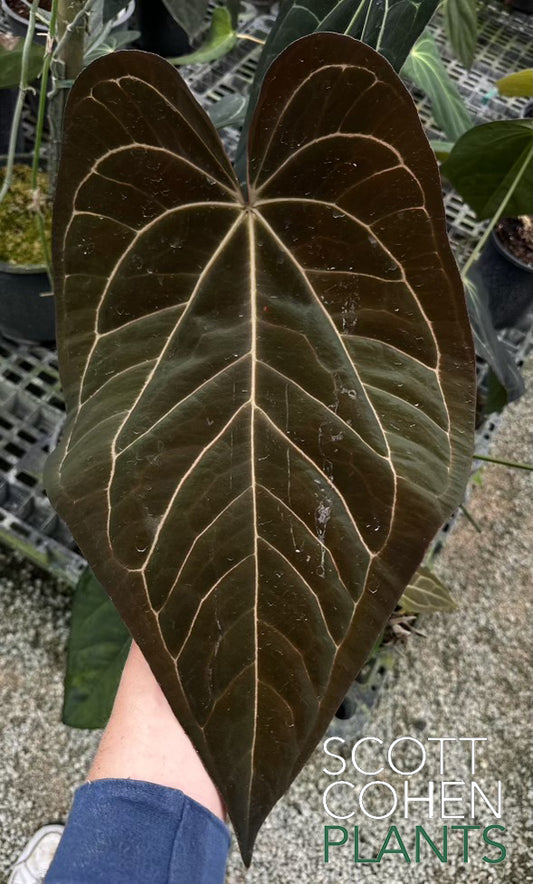
Ears (Lobes): The rounded segments at the top of the leaf where it meets the petiole. Lobe size and shape are primary identifiers in hybrid classification.
Sinus: The space or indentation between the two lobes.
Sinus Types & What They Reveal
• Open Sinus: A wide, spacious gap between lobes.
• Overlapping Sinus: Lobes fold over one another, creating the classic "heart" shape. Seen in A. Wonderboy, and many velvet-leaf types. Overlap increases with maturity and proper care.
• Fused Sinus: Lobes are physically joined, forming a continuous circle around the petiole. A rare and highly desirable trait in certain breeding lines generally with influence from A. Forgetii.
• Flat Sinus: Nearly straight across with minimal indentation. Often seen in plants like A. Portilla “Dorito”, A. Ftg Crystallinum, A. Delta Force.
Mutation: Plants displaying non-standard traits such as sandpaper-like textures, "blister" variegation, or irregular leaf shapes. These aberrant forms are highly sought after by advanced collectors and can command premium prices.
Anthurium Breeding & Propagation Terms
Understanding how rare Anthuriums are propagated helps you evaluate rarity, stability, and potential.
Propagation Methods
Offset (Clone): A genetically identical plant grown from a vegetative propagation of the original plant, such as leaves, stem roots.These are true clones—what you see is exactly what you get. The gold standard for preserving elite genetics.
Tissue Culture (TC): Plants grown from individual cells in a sterile lab environment. While technically clones, TC plants can occasionally show muted traits or slight variations compared to the original specimen. This is normal and doesn't indicate inferior genetics.
Breeding Terminology
Self from Seed (S1/F1): First-generation seedlings where the mother and father are the same plant (e.g., "Carla Self"). These show some genetic variation while generally maintaining core parent traits.
The Hybrid Formula: We always list parentage as (Mother) × (Father)—the seed parent first, pollen donor second. This standard notation helps collectors track lineages and predict offspring traits.
Example: "Portillae Dorito × BVEP" means Portillae Dorito was the seed parent and Black Velvet Eastern Panama provided the pollen.
"× ?" indicates the pollen donor was a lost hybrid or unknown pollinator—common in older breeding lines where records weren't maintained.
The Wonderboy Series: Identification Guide
The "Wonderboy" name represent a legendary 30+ year breeding lineage from Tim Anderson and specific individual selections.
Leaf Color & Texture
Key Identifying Traits
Wonderboy Pink
Most intense wide silver veining
New leaves emerge pink; wide silver veins; ruffled/bubbly leaf texture and edges
Wonderboy A
Black background thick white/silver veins on mature leaf.
New leaves emerge red/purple; leaf is more rounded when mature; short petioles
Wonderboy B
Black background
Elongated (oblong) leaf shape; thinner veining; longer petioles. Emergent leaves intense purple color.
Note: We offer specific selections from the Wonder Boy lineage, as well as our own unique "Wonder Boy" individual plants developed through our breeding program.
Notable Botanical Partners & Installations
• Gardens by the Bay, Singapore
• Nong Nooch Tropical Botanical Garden, Thailand
• Amazon HQ (The Spheres), Seattle
• Walt Disney World's Animal Kingdom
Advanced Care & Propagation Techniques
How to Propagate Long-Stemmed Anthuriums
Pro Tip for "Mile of Stem" Plants: Use the deep planting method. Pot the plant so the soil level reaches just under the first leaf. Once the buried stem produces several strong roots into the substrate (typically 4-8 weeks), you can cut it and plant with higher success rate. This technique is far more reliable than trying to root bare stem cuttings.
Why Anthurium Veins Change Color
Temperature is the secret. Many species —display their most vibrant vein coloration in cooler conditions. When nighttime temperatures drop into the 60s or low 70s°F, and daytime time temps in upper 70’s low 80’s you'll see significantly more intense color. During summer heat, the same plants may appear more silvery or plain green. This is normal and reversible. NOTE: A drawback of the cooler temperatures as many species will grow slower, this does not affect plant health, just the speed of growth.
Environmental Stability for Velvet-Leaf Species
The #1 mistake collectors make: Moving plants between environments too frequently. Aroids, particularly velvet-leaf species, are extremely sensitive to humidity and light changes. Moving a plant from a high-humidity cabinet to ambient room air (or vice versa) repeatedly will cause severe stress, leaf damage, and stunted growth. Pick a spot with consistent conditions and leave it there.
Decoding Scott's Nursery Labels
What Do the Yellow Tags Mean?
Yellow tags are simply our internal greenhouse location coding system (e.g., "Greenhouse 6, Right Side"). They're not special price tiers, secret mutations, or quality indicators—just logistics to keep our operation running smoothly.
OG vs. RA Labels Explained
• RA: Plants officially numbered and cataloged by renowned collector Rory Antolak
• OG: Plants acquired from Rory before he began his formal numbering system
Both represent exceptional genetics from the same trusted source.
Winter Shipping: The 40-Degree Rule
Protect your plants: If your local overnight temperatures drop below 40°F, you must add a heat pack, under 32 adding insulation to your order is strongly recommended. These are available in our Shipping Supplies section.
We want your plants to arrive in perfect condition, ready to thrive in your collection.
Have questions about specific terms or want to discuss advanced breeding techniques? We are here to support collectors at every level. Shop our current rare Anthurium and Aroid selection with confidence. And join us on Palmstreet where we can answer questions live!